Episode 325 - Calf Transport: Why Early-Life Management Matters More Than Miles - UMN Extension's The Moos Room
00;00;11;03 - 00;00;38;09
Brad
And welcome to The Moos Room, Brad, here on a wonderful winter day. Very nice and cold in Minnesota right now. Minus five Fahrenheit, -23 Celsius. So it's quite cold. We're in deep winter and it's only mid-December. I hope it doesn't bode well for the rest of the winter. Maybe it's going to be cold and snowy. At least that's what's predicted.
00;00;38;11 - 00;01;08;29
Brad
We'll move on. Cows are doing well. Maybe a little bit of frostbite when it was -41 day with some wind. A little bit of frostbite on some, but not bad. But overall, cows are doing well. Calves are doing well and the calves look really good. But today I wanted to talk about calves again. I think a new study just came out on really reframing calf transport, kind of a landmark study on what truly matters for health and survival.
00;01;08;29 - 00;01;49;19
Brad
And this study was from Gustavo Schulman and one Pinero, who are both at Ohio State University and Texas A&M. And they had just published a study in the Journal of Animal Science on short and long distance transport, health, survival and growth of pre weaned dairy calves and dairy beef crossbred calves. So we think about transportation of animals. You know in the US most newborn dairy calves particularly the non replacement calves are moved off site shortly after birth which requires a lot of transportation.
00;01;49;19 - 00;02;20;04
Brad
And the transportation of these pre wean dairy calves has certainly triggered a lot of debate. And really recently due to animal welfare concerns obviously directly associated with their health status, survival and overall performance. You know it is interesting we we did not transport our calves okay. We transport them from maybe the maternity area down to the calving area to minute trip.
00;02;20;07 - 00;03;02;07
Brad
But a lot of animals, especially in the north, are getting transported to the southern US, to be raised just because of really winter. The perception that you can't grow good heifers up here in the north in the winter. I disagree with that. I think you can grow wonderful dairy calves up here in the winter. I think the bigger thing is it comes down to facilities, takes a lot of winter facilities, barns, you name it, to raise calves up here in the north so you can raise them in the south with a lot less infrastructure, you know, and I know farms here in Minnesota and Wisconsin that transport animals to Kansas.
00;03;02;09 - 00;03;25;21
Brad
Some farms in South Dakota transport them to Kansas, uses a big calf rearing facility in Kansas. I think over 100,000 animals on site. I know the University of Florida transports their animals from Florida to Kansas, or at least they did the last time I talked to some people there. Now that's a long trip. That's 14, 15, 16 hours.
00;03;25;23 - 00;03;57;26
Brad
So animals are traveling long distances. So really, I think the big discussion comes in, you know, trying to focus on key stressors of the journey that these animals take, the restricted access to water and milk. So, you know, not having exposure to water and milk for a long time, they're getting commingled with each other. There's lots of different environmental exposures, especially coming from the north, or today it's below zero.
00;03;57;26 - 00;04;34;12
Brad
And you go to the south and it's 30, 40, 50 degrees even further south. It can be 70 degrees in just a 24 hour time period. These calves are going through major environmental exposures. So I think the, you know, the kind of prevailing hypothesis of this study, the one that really was trying to look at was calves that were exposed to transport longer than eight hours will have increased incidence of diarrhea and pneumonia, decreased survival and reduced average daily gain pre weaning.
00;04;34;12 - 00;05;16;17
Brad
So this is what the study was going to look at. So what about these calves. Where did they come from. So this was actually a pretty unique data set. This kind of retrospective observational study tracked 392,000 calves. You know dairy females, dairy beef crosses from 15 farms operating under the same overall management. So basically these calves, they had a north system and they had a south system, basically had two calf raising facilities, similar housing and environment.
00;05;16;20 - 00;05;51;02
Brad
And this data was collected over a two plus year time period from January 2022 to March of 2024. So basically calves are transported in for duration groups, kind of estimated distances that ranged from about a half hour. And some were transported 24 hours. So if you think about the North's system for these animals, they kind of were all collected from these farms up here or collected in a central collection area where they made the trip.
00;05;51;02 - 00;06;22;18
Brad
The dairy females kind of made a 17 hour trip to the southern system in Arizona. Dairy beef cross calves made basically a 24 hour transport system into Arizona. Some of them made shorter trips, eight hours or some were eight hours. Some were short trips to the collection facilities. But basically lots of traveling for these animals. So how are these calves kind of handled beforehand?
00;06;22;18 - 00;06;55;09
Brad
So basically we had dairy replacement heifers. They were transported from a half hour or 24 hours. Dairy beef crossed calves were transported 8 or 17 hours. And all of the calves were from basically Jersey Holstein crossbred dam. So these are all crossbred animals. So calves were shipped following kind of a conditioning protocol that involved four consecutive feedings. Basically, the fourth was mixed with electrolytes, ensuring that they were not showing any signs of sickness.
00;06;55;11 - 00;07;30;26
Brad
And they had really dried umbilical cords. What about handling? Well, basically, and handling and transport. They use specialized methods, which included a strap harness and an articulating arm lifter to ensure gentle handling during loading and unloading is quite interesting to see these loading unloading. I've seen it before on these farms. Basically, it's a strap that goes around the calf front and back and basically lifts them from where they're at into the truck.
00;07;30;29 - 00;08;09;12
Brad
It also helps with safety of humans as well. You know, you're not, you know, straining on your back trying to lift animals. So every animal has a harness, everything was put in there and calves were sourced directly from the system farms. They weren't from auction markets, which reduced their disease exposure and stress. So basically, calves born in the south, they were either transported a half hour, eight hours, were fed one colostrum meal, while those in the North system that were transported longer, 17 or 24 hours were fed a second colostrum meal six hours later.
00;08;09;14 - 00;08;33;09
Brad
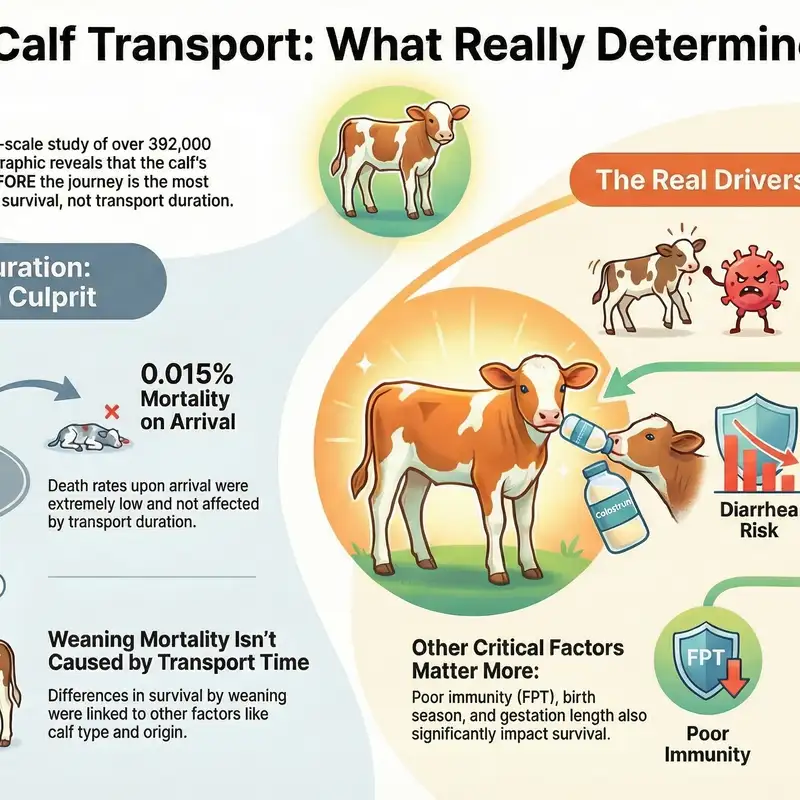
So you think about transport. These animals are being transported a lot. They're very young, less than a week of age, a few days of age when they're young, fed colostrum, off they go. What did the results look like in this study? Well, kind of the first surprise was mortality upon arrival was really negligible. And unaffected by transport duration.
00;08;33;12 - 00;09;12;07
Brad
Most people would think that, oh, you're traveling a long distance, all these kids are going to die. You're going to have a lot of issues. Well, across the 392,000 calves and these four different journey lengths that they have, the overall mortality upon arrival was very low .01 5% overall, the calves half our transport .015 eight hours less than .01 17, our transport about .025, and the 24 hour transport about .01.
00;09;12;09 - 00;09;44;00
Brad
This was upon arrival, upon arrival, so very low mortality rate while they're traveling in trucks, very few calves died out of the 392,000 while they were being transported. But this study also looked at what happens at weaning at 60 days. So however, you know, when weaned at 60 days, there's a little bit maybe a more different and more complex picture that kind of shows up in these animals.
00;09;44;00 - 00;10;15;28
Brad
So while the journeys immediate impact was quite minimal, very low, the study found significant differences in overall calf mortality by the time of weaning. So weaning was about 60 days. So the overall rate of mortality was 2.49%. And this did vary by transport group. But even if you think about it, 2.49% was about 9760 calves out of 392,000.
00;10;15;28 - 00;10;42;26
Brad
In the study, I think 2.5% is very low. We have a little bit less at our farm I don't like to have. I think it looks less than 1%. Some farms have seen 10% or greater on calf mortality. I think that's inexcusable. I think, you know, we should be shooting for less than what, at least 5%, if not 1 to 2% calf mortality by the time animals are weaned.
00;10;42;29 - 00;11;15;03
Brad
So this study really showed that 2.5% at 60 days of weaning. So the calves that had the highest mortality was seen with just a half hour transport group. So 3.56% to eight hour transport group which had the lowest mortality, 1.01% to 17. Our group was 2.18% and the 24 hour group had 1.55 mortality. So really low across that.
00;11;15;03 - 00;11;48;05
Brad
But the surprising difference was the calves that had the highest mortality were transported the shortest distance just a half hour. But if we dive a little bit deeper into it and think about it from a disease incidence, the highest incidence of diarrhea. So calf scours basically was observed in replacement heifers transported a half hour in 24 hours, which basically showed that calves fed two colostrum meals were about 50% less likely to develop diarrhea compared to those that fed one meal.
00;11;48;07 - 00;12;12;27
Brad
So isn't that interesting? The more colostrum that we're feeding these animals, the less likely they are to basically develop calf scours. So that might have implications for everybody that's feeding dairy calves. The more colostrum, more colostrum meals that these young calves get. In this case, two these animals develop less hours. And if you just fed one colostrum meal, what about pneumonia?
00;12;12;27 - 00;12;45;12
Brad
The highest incidence of pneumonia was found in dairy beasts, cross-bred calves that were transported 17 hours, about 9.5%. And then the failure of passive transport was also recorded. So these calves were collected blood samples to be sure if they got adequate antibodies. And basically calves that experience failure of passive transport. So serum total proteins that were less than 5.1% basically had increased mortality.
00;12;45;12 - 00;13;30;17
Brad
So calves that had low total serum proteins had increased mortality. And we know that many studies have shown that less than 5.1. But the failure of passive transport was significantly lower in calves fed to colostrum meal. So remember go back to two colostrum meals. Higher serum total proteins and less scours. So average daily gain for dairy calves transported 24 hours was 1.68 pounds per day, or about 0.76kg per day, and they had higher average daily gain than those animals that were just transported a half hour, which was 1.4 pounds per day, or about 0.65 kilos per day.
00;13;30;17 - 00;13;53;27
Brad
And really, this difference that was found was mainly attributed to the confounding effect of dam parity. So first, lactation animals versus older calves. We'll talk about this in a minute. And basically if you think about it from the dairy beef crossbred calves, average daily gain did not differ between these dairy beef cross calves that were transported either 8 hours or 17 hours.
00;13;53;29 - 00;14;20;28
Brad
So the eight hours was from Arizona to Mexico, 17 hours, Minnesota to New Mexico. So it was interesting. The study also did some what we call multivariate analysis that looked at all of the factors that were possibly related, you know, key health events, biological conditions early in life. And they probably play a much larger role in calf mortality than transportation.
00;14;20;28 - 00;14;54;04
Brad
So basically, it showed that the data really revealed that a calf's destiny is largely sealed before the wheels start rolling. So what were those primary drivers of pre weaning mortality in these animals? Calf diarrhea over 30%. So calf diarrhea is probably the most important driver of mortality. There's all of these other ones pneumonia about 7% birth system you know south versus north about 7% gestation length dam parity failure of passive transfer, calf sex and breed.
00;14;54;07 - 00;15;25;01
Brad
And then the transport. So basically disease immunity and environment explained over 68% of the mortality risk in these animals. So what about colostrum management. Certainly cluster management is a critical determinant of cattle health. So really this study provided a clear link between the number of colostrum meals and subsequent health outcomes. Two things that were really driving calf mortality were failure of passive transfer and diarrhea.
00;15;25;01 - 00;15;54;20
Brad
If we think about it from remember that one meal versus two meals of colostrum, failure of passage transfer was about 1.3% for one meal and less than 1% for two meals. So basically, calves that were fed two meals had higher serum protein levels and a reduced failure of passive transfer by over 70%. So calves that were fed two colostrum meals were 50% less likely to develop diarrhea.
00;15;54;20 - 00;16;20;10
Brad
So that's pretty important. Pretty important. So now a lot of this goes back to colostrum management. So what about some of these other key factors that I just talked about. Dam parity which first lactation or older cows birth season and gestation length also significantly predict calf survival. These are the ones that were probably the most important outside of health problems diarrhea, pneumonia.
00;16;20;10 - 00;16;43;06
Brad
So calves from first class heifers had a higher risk of mortality. So the odds was 1.5% greater compared to the older cows. So maybe a little bit lower mortality for first calf heifers probably goes back to colostrum. You know we've done studies here that show that colostrum quality is not as high in first calf heifers. It is the older cows.
00;16;43;06 - 00;17;12;19
Brad
So that could be contributing to that factor as well. Birth season. So summer births and winter births were associated with the highest mortality risk compared to spring. So animals that were born in the spring less mortality than those in the summer or the winter and gestation length so short gestation length so 254 to 269 days significantly increased mortality risk compared to animals that had longer gestation length.
00;17;12;19 - 00;17;40;12
Brad
So odds of 1.9% greater in pre ween mortality if you had a short gestation. So longer gestation was good. So the effect of transport during is really heavily confounded by calf and system characteristics. So the higher mortality in the half our transport group was maybe not a result of the short journey itself, maybe some of the other issues that we have.
00;17;40;12 - 00;18;17;00
Brad
So what happened in the half hour transport group, basically the calves, these were exclusively dairy replacement heifers. So they were not dairy beef crossbred calves. They were all born to first calf heifers. They were all born in the south system. So more heat stress for those animals and immunity. The calves in the South system that were only transported a half hour received only one colostrum meal, and they had higher rates of failure of passive transport compared to the M compared to the calves in the north.
00;18;17;00 - 00;18;39;15
Brad
So those probably I'll go back to it. So you have exclusively dairy first calf heifers born in the South, heat stress and fed one less colostrum meal about average daily gain. If we really look at it briefly based on the either dairy heifers or dairy beef crossbred calves, there really wasn't much difference to the dairy heifers that were transported.
00;18;39;15 - 00;19;04;21
Brad
24 hours had greater average daily gain compared to the animals that were transported. Just a half hour kind of goes back to what we had talked about before, kind of confounded by first calf heifers and born in the South, the dairy beef crossbred calves, no difference in growth whether they were transported 8 hours or 17 hours. Basically, they all grew the same.
00;19;04;21 - 00;19;33;18
Brad
So what about kind of the key findings to kind of wrap this up? Basically, you know, the conversation probably must shift in these animals. A calf journey begins long before it leaves the farm, basically, while a causal relationship between transport duration and survival or average daily gain could not be established with this study. Basically, these findings show that key health related factors early in life play a much larger role in calf mortality at weaning.
00;19;33;20 - 00;20;03;05
Brad
Then did the transport duration and what are some of these key things for really improving calf outcomes? Colostrum management. So implementing two meal protocols to drastically reduce that failure of transportation and scours dam health. So really focusing on the pre part of management to optimize gestation length and support calves from first calf heifers. Environmental management has lots of environmental things that can happen.
00;20;03;08 - 00;20;28;06
Brad
Basically mitigating seasonal stressors, probably heat stress in the summer, especially in the south. So if you're in the south, reducing heat stress is probably important. We get heat stress here in the north too. I think even just reducing some heat stress in the north can help out as well. And then genetic selection. So recognizing that there's inherent differences in breeds even between dairy beef crossbred calves.
00;20;28;08 - 00;20;58;15
Brad
And really we should think about selecting for some of these health traits. Less disease resistance less pneumonia, less scours. So basically, the study concluded that while calf mortality at arrival was extremely low and unaffected by transport duration, overall mortality at weaning was more influenced by these early life factors such as disease, failure of passive transport and colostrum feeding, then by duration of transport alone.
00;20;58;15 - 00;21;18;22
Brad
So really the data is clear. Preparing a calf for successful life is the best way to have a safe journey. So with that, I hope you learned some interesting facts on this transport study that, you know, really, maybe it's much more about that early life and how we we raised these animals versus trucking them all over the United States.
00;21;18;22 - 00;21;38;14
Brad
And with that, if you have any comments, questions, or scathing rebuttals, I'd be happy to hear them. You can contact me at the Moose Room model S r o m at U Amanda Edu or find me on the web. W Crock Dairy on Instagram or University of Minnesota Livestock Extension. Thanks for listening. I hope you stay warm.
00;21;38;14 - 00;21;39;18
Brad
Talk to you later. Bye.